How to Fix Your AI Visibility: 3 Quick Wins 98% of Sites Are Missing
98% of e-commerce sites lack Product schema. Here are 3 actionable fixes you can implement this week to improve your AI search visibility.
Joelle
2026-01-23 · 5 min min read
 Perplexity
 Claude
 Gemini
<em>This is Part 2 of my AI visibility analysis. If you haven't read it yet, start with <a href='/blog/ai-visibility-gap-part-1' class='text-blue-600 hover:underline font-bold'>Part 1: The AI Visibility Gap Study</a>.</em>
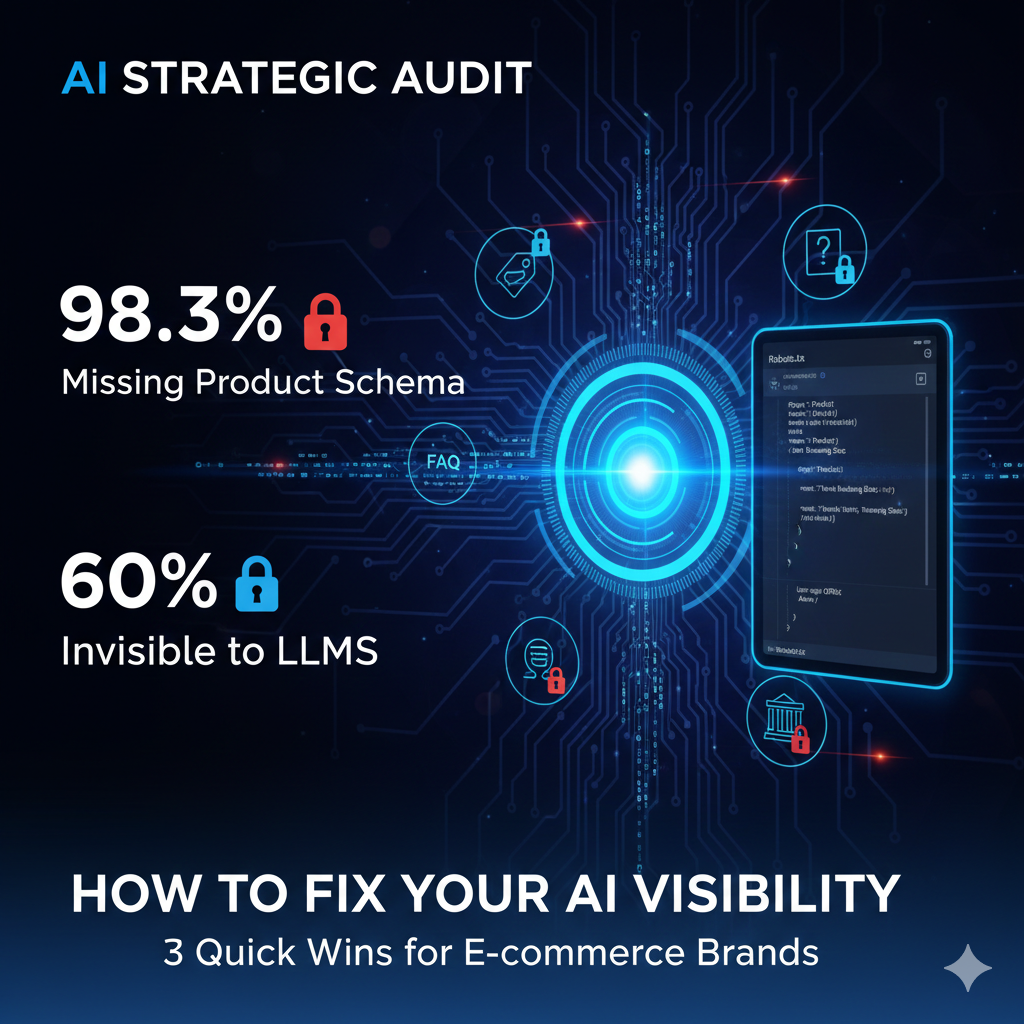
How to Fix Your AI Visibility: 3 Quick Wins 98% of Sites Are Missing
The Problem (Quick Recap)
In <a href='/blog/ai-visibility-gap-part-1' class='text-blue-600 hover:underline font-bold'>Part 1</a>, I shared what I learned from analyzing 409 e-commerce sites:
- <strong>98.3%</strong> lack Product schema
- <strong>60%</strong> are invisible to LLMs during discovery
- Average score: <strong>25.6/100</strong>
- Only <strong>0.7%</strong> scored above 80/100
The AI visibility gap is real. And it's happening <strong>right now.</strong>
So what do you do about it?
What This Means for E-commerce
Tom Goodwin's point about 'LLM shopping' isn't theoretical—it's happening right now:
- ChatGPT had <strong>2.6 billion daily queries</strong> as of July 2025
- <strong>2.1%</strong> of those queries are shopping-related
- That's <strong>52 million shopping queries per day</strong>
<strong>Before</strong> dedicated shopping features launched.
The discovery battle is already underway. And 60% of brands are sitting it out without even realizing it.
The Quick Wins 98% of Sites Are Missing
1. Add Product Schema to Your Top 20% SKUs (2-4 hours)
Only <strong>1.7%</strong> of sites have this. It's the biggest opportunity.
{
  "@context": "https://schema.org",
  "@type": "Product",
  "name": "Men's Running Shoe - Model X",
  "description": "Lightweight running shoe with carbon fiber plate",
  "image": "https://example.com/shoe.jpg",
  "brand": {
    "@type": "Brand",
    "name": "Your Brand"
  },
  "offers": {
    "@type": "Offer",
    "price": "129.99",
    "priceCurrency": "USD",
    "availability": "https://schema.org/InStock"
  },
  "aggregateRating": {
    "@type": "AggregateRating",
    "ratingValue": "4.7",
    "reviewCount": "89"
  }
}
<strong>Impact:</strong> Your products can now appear in AI-powered comparisons.
<strong>How to implement:</strong>
- Start with your best sellers (20% of SKUs = 80% of revenue)
- Use your existing product data
- Add to product page templates
2. Add FAQ Schema for Common Questions (1 hour)
When customers ask LLMs about your policies, make sure the AI can find and cite your answers.
{
  "@context": "https://schema.org",
  "@type": "FAQPage",
  "mainEntity": [{
    "@type": "Question",
    "name": "What's your return policy?",
    "acceptedAnswer": {
      "@type": "Answer",
      "text": "30-day free returns on all orders. No questions asked."
    }
  }, {
    "@type": "Question",
    "name": "Do you offer free shipping?",
    "acceptedAnswer": {
      "@type": "Answer",
      "text": "Free shipping on orders over $50 within the continental US."
    }
  }]
}
<strong>Impact:</strong> When someone asks 'what's the return policy for [your brand]', LLMs can extract and cite your answer directly.
<strong>Quick wins:</strong>
- Return policy
- Shipping information
- Warranty details
- Size guides
3. Audit Your Robots.txt (5 minutes)
20% of sites inadvertently block AI crawlers.
<strong>Check for:</strong>
- Blocking <code>/products/</code> directory
- Blocking <code>/api/</code> endpoints with product data
- Blocking JavaScript needed to render content
<strong>Impact:</strong> You're now discoverable by AI search engines.
The SEO Parallel Everyone's Missing
Remember 2005-2008?
CMOs said: 'SEO is niche. Our customers find us through other channels.'
Then Google became the default entry point for commerce.
Early SEO investors (Zappos, Wayfair) compounded their advantage. Laggards spent years catching up—throwing budget at Google Ads just to stay visible.
<strong>We're at that same inflection point with AI search.</strong>
The difference?
With SEO: you could throw budget at Google Ads to catch up.<br>With AI readiness: it's your <strong>data architecture</strong> that matters.
You can't buy your way into an LLM's context window.
The brands that structure their data <strong>now</strong> will compound their advantage. The brands that wait will explain to their board in 2027 why they're invisible to the fastest-growing search channel.
Why Shoes Beat Beauty by 44%
In my analysis, Shoes sites averaged <strong>31.8/100</strong> while Beauty averaged <strong>22.0/100</strong>.
That's a <strong>44% difference</strong>.
After analyzing the data, the pattern is clear:
<strong>Shoes brands</strong> cluster on Shopify Plus → better structured data defaults.<br><strong>Beauty brands</strong> use older platforms → structured data is an afterthought.
This isn't about budget or technical sophistication.
It's about <strong>platform choice</strong>.
If you're rebuilding your stack in 2026, make AI readiness a selection criteria—not an afterthought.
What to Do Next
<strong>If you're an e-commerce brand:</strong>
- Audit your site (View Source → search for 'application/ld+json')
- Check for Product schema (not just Organization)
- Start with your top 20% SKUs
- Add FAQ schema for common questions
- Monitor your AI visibility
See how your e-commerce site compares to the 409 sites analyzed. Get a detailed AI readiness report in seconds.
<strong>Coming next in this series:</strong>
- How the top 0.7% structure their data
- Platform comparison (Shopify vs WooCommerce vs Magento)
- Measuring AI referral traffic
Follow me on <a href='https://linkedin.com/in/ai-audit-strategic' target='_blank' class='text-blue-600 hover:underline font-bold'>LinkedIn</a> for updates.
Ready to Check Your AI Visibility?
See how your e-commerce site compares to the 409 sites I analyzed. Get a detailed AI readiness report in seconds.