GEO, AEO, LLMO, GSO: The Acronym War Is Over. Here's What Actually Matters.
GEO, AEO, LLMO, GSO: four acronyms, one debate. We settle it with first principles and data from 5,609+ sites across 15 industries. Here is what actually matters for AI visibility in 2026.
Joelle
2026-03-17 · 8 min min read
 Perplexity
 Claude
 Gemini
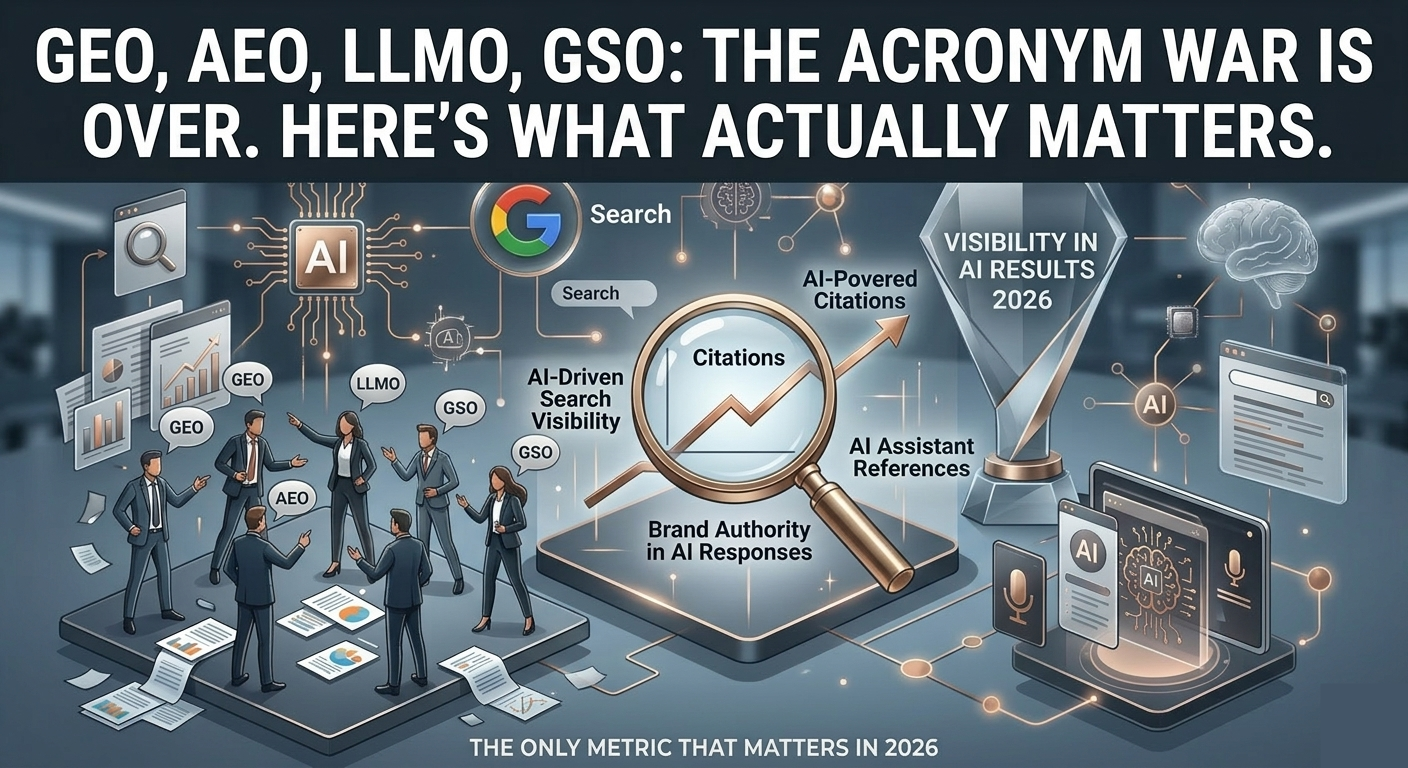
Four acronyms. One debate. One metric that matters.
Every few months, a new acronym surfaces in the SEO community: GEO, AEO, LLMO, GSO. Each one arrives with a Medium post, a LinkedIn carousel, and a vendor claiming to have invented the discipline. Here is the truth: the acronym war is a distraction. While agencies debate terminology, your brand is either being cited by AI assistants or it isn't. This article settles the debate with data and first principles.
What Is SEO, AEO, and GEO? A Clear Definition of Each Term
SEO needs no introduction: thirty years of optimizing for crawl, index, and rank pipelines, backlinks, and keyword density. It works. It still works. It is the foundation.
AEO (Answer Engine Optimization) emerged around 2018 with the rise of voice search: Siri, Alexa, Google Assistant. The goal was simple: structure content so that AI-powered assistants extract a direct answer without requiring a click. Featured snippets, People Also Ask boxes, Position Zero. AEO was always about one thing: making your content the answer, not just a result.
GEO (Generative Engine Optimization) was formally defined in academic research presented at KDD 2024 by researchers from Princeton, Georgia Tech, the Allen Institute for AI, and IIT Delhi. It entered mainstream marketing vocabulary in 2025. The distinction from AEO: GEO targets large language models (ChatGPT, Gemini, Claude, Perplexity) that generate an original response, rather than extracting a snippet from a single page. GEO is about being the source that the model synthesizes from, not just the page that gets pulled.
Why Are GEO, AEO, and SEO Converging in 2026?
These acronyms are collapsing into each other for one simple reason: architecture. Most AI search experiences now rely on the same underlying mechanism: Retrieval-Augmented Generation (RAG). When you ask Perplexity a question, it retrieves relevant pages in real time, then synthesizes an answer. When ChatGPT with browsing enabled responds, same pipeline. When Google's AI Overview appears above your search results, same pipeline.
The signals these systems evaluate are also converging:
- Structured data (FAQ, HowTo, Article schema): the same signals AEO has always prioritized
- E-E-A-T (Experience, Expertise, Authoritativeness, Trust): formalized by Google for snippets, now critical for LLM citation
- Entity clarity: is your brand a known, unambiguous entity in the knowledge graph?
- Content freshness: recency signals RAG systems use to prioritize sources
- Citation-worthy claims: data-backed, verifiable statements that LLMs prefer to extract
The companies building AI search, Google, OpenAI, Perplexity, and Anthropic, are all optimizing for the same quality signals. The result: a practitioner implementing AEO correctly is already implementing GEO. The overlap is substantial.
What Does GEO Add That AEO Does Not Cover?
GEO is not just AEO with a fresh coat of paint. It meaningfully extends the discipline in three areas.
1. Off-site brand presence matters more than ever
Traditional SEO focused almost exclusively on your own domain. GEO rewards brands that exist across the web: Reddit discussions, LinkedIn posts, third-party reviews, Wikipedia and Wikidata entries, earned media mentions. In recent analyses of LLM outputs, Reddit and LinkedIn consistently appear among the most cited domains. If your brand only lives on your own website, LLMs have fewer signals to draw from.
2. Entity disambiguation becomes a first-order problem
LLMs are probabilistic. They confuse brands with similar names, conflate a company with its founder, or misclassify a luxury wellness clinic as a telemedicine platform because metadata is missing. Classic AEO relied on Google's index and link graph to handle disambiguation. LLMs are less forgiving. Wikidata entries, explicit JSON-LD sameAs declarations, and dedicated disambiguation content are now GEO-specific requirements with no equivalent in traditional AEO practice.
3. Citation tracking is a new measurement category
SEO gave us rankings. AEO gave us featured snippet capture rates. GEO introduces a metric neither discipline previously required: citation rate, the percentage of relevant AI-generated responses in which your brand is mentioned. This is not a ranking. It is not a click. It is pure brand presence inside the answer itself.
What Does Our Data Show? AI Citation Rates Across 5,609+ Sites
Across our analysis of 5,609+ websites across 15 industries, a consistent pattern emerges: most brands have no idea whether AI assistants are citing them. They track rankings. They track clicks. Some track AI Overview impressions. Almost none track citation rate across ChatGPT, Gemini, Claude, and Perplexity on the queries that matter most for their category.
A Practical Framework for 2026: Three Layers, One Strategy
Instead of choosing an acronym, use a three-layer framework that covers SEO, AEO, and GEO simultaneously.
- Layer 1, Technical Foundation (SEO + AEO). Crawlability, indexation, Core Web Vitals. FAQ/HowTo/QAPage schema. hreflang for multilingual sites. These are non-negotiable prerequisites. Without them, GEO is impossible: LLMs cannot cite what they cannot find.
- Layer 2, Content Authority (AEO + GEO). Question-based headings aligned with real user queries. Data-backed claims with verifiable sources. Named, credentialed authors. Regular freshness updates with visible Last updated dates. Content depth that earns citations rather than just ranks.
- Layer 3, Entity Presence (GEO only). Wikidata entry. Wikipedia mention where warranted. LinkedIn company page with a consistent brand description. Third-party mentions in industry publications. JSON-LD with sameAs declarations linking your domain to authoritative entity records. This layer separates brands that exist in the LLM knowledge graph from brands that are invisible to it.
Frequently Asked Questions About GEO, AEO, and SEO
The Verdict: SEO, AEO, and GEO Each Win a Different Surface
GEO did not replace AEO. AEO did not replace SEO. The reality is simpler: the discovery landscape fragmented, and each acronym describes a different surface within that fragmented landscape.
- SEO wins the blue links
- AEO wins the snippets and voice responses
- GEO wins the AI-generated answers that now account for a growing share of how people find products, services, and information
Gartner projects a 25% drop in traditional search engine volume by 2026 as users shift to AI chatbots and virtual agents. Independent analyses suggest AI Overviews reduce click-through rates for top-ranking pages significantly on affected queries, while AI referrals to leading sites are growing as answer engines cite a smaller and smaller set of authoritative sources per response.
Call it GEO. Call it AEO. Call it whatever helps your team prioritize it. Just make sure your brand is in the answer.
Scan your site across ChatGPT, Gemini, Claude, and Perplexity. Free audit in 30 seconds.
Sources
| # | Source | Date |
|---|---|---|
| 1 | Princeton University et al., "GEO: Generative Engine Optimization," KDD 2024 | 2024 |
| 2 | Digiday, "WTF are GEO and AEO? (and how they differ from SEO)" | Oct 2025 |
| 3 | Averi.ai, "What Is AEO? What Is GEO? And Why Should Marketers Care?" | 2025 |
| 4 | Exabytes, "SEO vs GEO vs AEO: Key Differences & Why They Matter" | 2025 |
| 5 | Gartner (via analyst commentary), "Search Engine Volume Will Drop 25% by 2026 as AI Tools Rise" | 2025 |
| 6 | AI Audit Scan, Proprietary dataset, 5,609+ sites across 15 industries | 2025–2026 |
Ready to Check Your AI Visibility?
See how your e-commerce site compares to the 409 sites I analyzed. Get a detailed AI readiness report in seconds.